
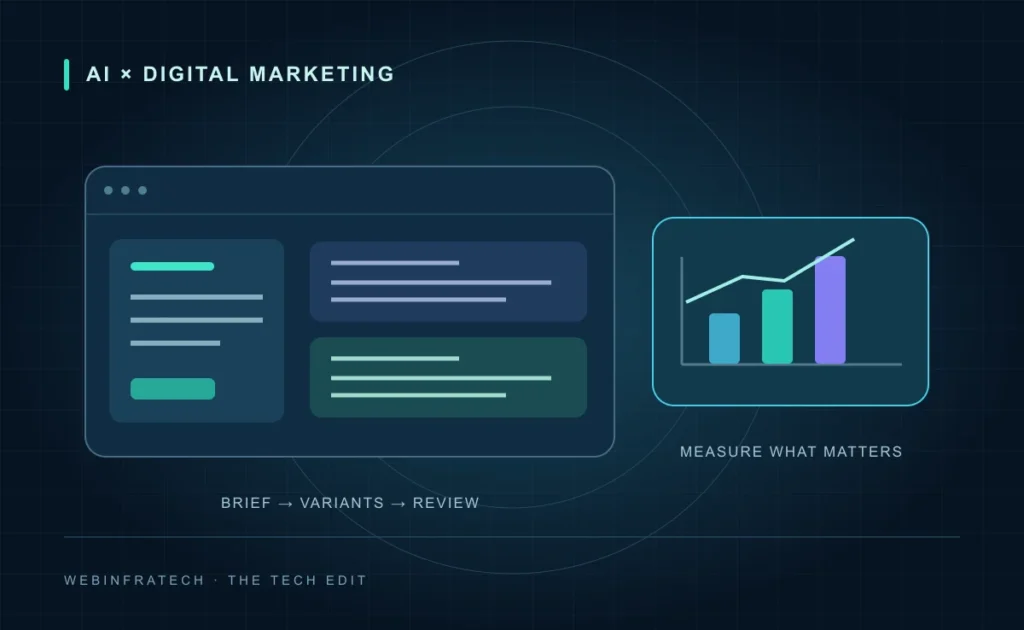
AI can help a marketing team organise ideas, prepare variations and summarise campaign data. It cannot decide what your business can honestly promise, whether an offer is still valid or whether an enquiry is commercially relevant. Those decisions need clear ownership.
A useful AI digital marketing workflow connects a verified brief to reviewed content and dependable measurement. The following process is a suggested working method, not a promise of rankings, conversions or advertising returns.
Start with the customer problem, not a prompt
Write a short campaign brief before generating copy. State the audience, the problem, the service being offered and the action the visitor should take. Add the evidence that supports each claim and the details that must not change.
For an illustrative website-development campaign, the brief might target businesses replacing an outdated enquiry website. The intended action could be a project discussion. Proof should come from genuine work the business has permission to show, not invented testimonials or performance figures.
Use AI for variations, then make an editorial decision
Ask for a small set of distinct approaches, such as a message focused on clarity, maintainability or customer experience. Compare each version against the same brief. More generated headlines are not useful if they all make the same vague claim.
- Check that service descriptions match what the team actually delivers.
- Verify prices, dates, exclusions and offer terms against the source.
- Remove unsupported superlatives, invented statistics and guaranteed outcomes.
- Review tone, readability, accessibility and the relationship between copy and image.
Google’s own advertising guidance says generated assets still need review for accuracy and policy compliance before publication. Generating an image or headline does not mean it is approved to run.
Make the landing page fulfil the advertisement
A visitor should not have to search for the service or offer that brought them to the page. Keep the headline, supporting evidence and call to action aligned with the campaign. Use a focused form that asks only for details needed to start a useful conversation.
Check the complete journey on a small screen: readable content, working navigation, visible validation and a clear result after submission. A high audit score is useful diagnostic evidence, but it is not proof that the campaign message or form will convert.
Define a meaningful lead before measuring success
A button click, a form start and a successfully received enquiry represent different events. Document which action you are measuring. A sales owner should also define what makes an enquiry relevant, such as a suitable requirement and a reachable contact.
For a proposed test, track the path from campaign visit to completed enquiry, then review lead quality separately. Exclude internal checks from decision-making where possible. Do not send names, email addresses or phone numbers to analytics event parameters.
Test one question at a time
Choose a hypothesis you can explain, for example whether a clearer service description improves relevant form completions. Change one important variable, decide the comparison method and review the evidence over an appropriate period. AI can help summarise the observations; the underlying data still needs checking.
Record what was changed and when. If tracking, the offer and the landing page all change together, it becomes difficult to explain the result. Avoid treating a short-lived increase in clicks as a dependable improvement in business outcomes.
Common questions
Can we publish AI-generated content without review?
That is not our recommended workflow. Assign a reviewer who can verify the claims, brand fit and intended customer experience before release.
Does using AI guarantee better SEO or cheaper leads?
No. Useful content, a sound website, appropriate targeting and reliable measurement still matter. Evaluate outcomes against a baseline rather than assuming the tool provides an improvement.
Build a campaign around a real business goal
Explore WebInfratech’s digital marketing services and SEO approach for the delivery work around the campaign. If enquiries need routing into business systems, our AI and ERP workflow guide explains how to keep that handoff controlled.
Further reading: Google Ads: generating, editing and reviewing image assets. Check the current platform rules and feature availability before launching a campaign.
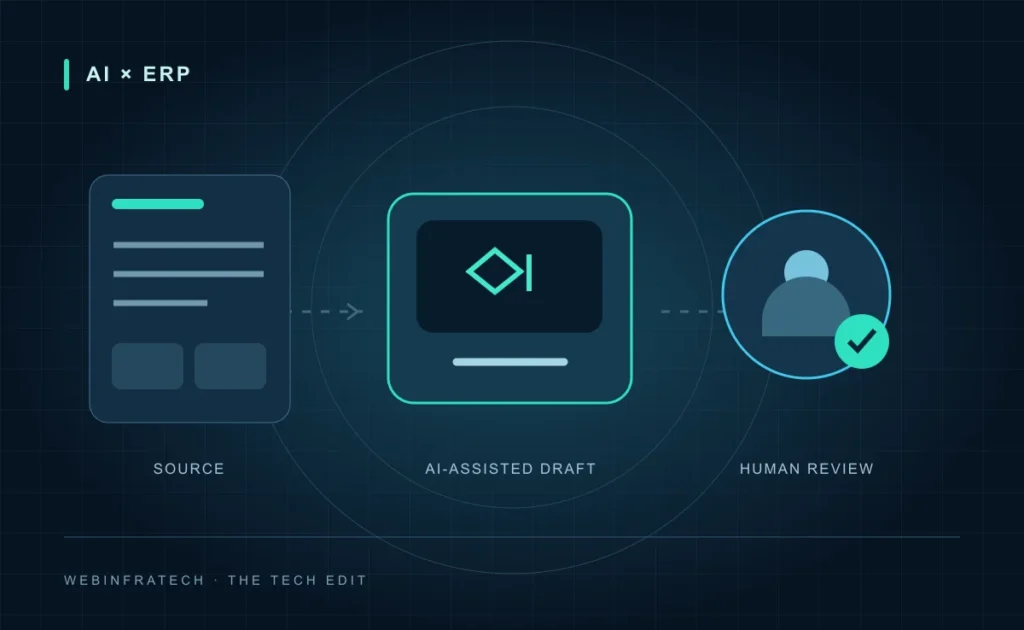 AI & INSIGHT
AI in ERP: Automate Workflows Without Losing Control
A practical guide to AI and ERP integration: choose a useful workflow, protect business data, keep approvals intact and measure results before scaling.
Read article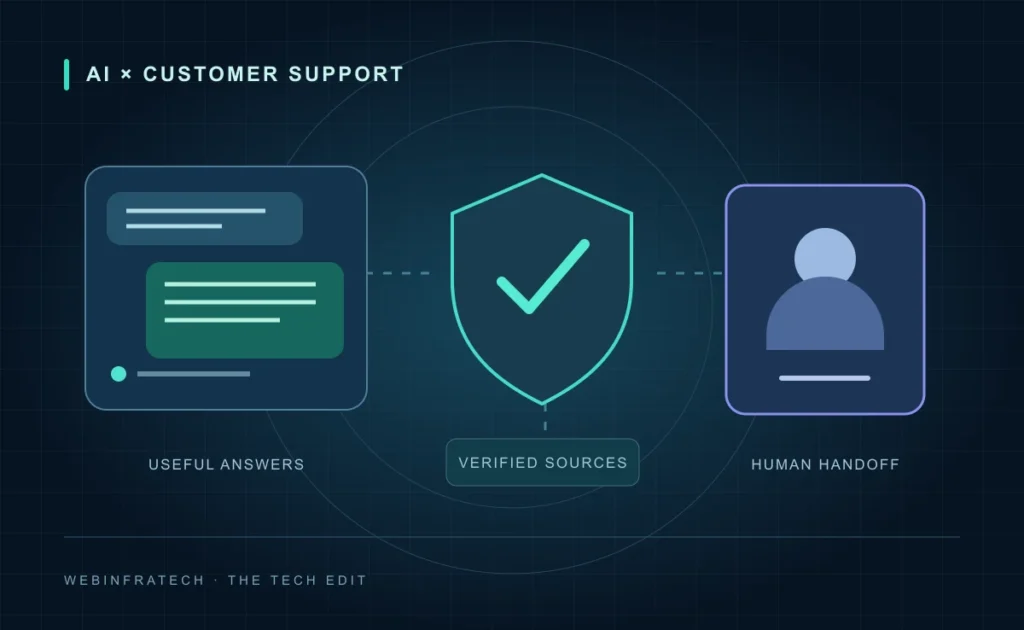 AI & INSIGHT
AI Customer Support Chatbots: Plan a Reliable Launch
Plan an AI support chatbot around trusted answers, protected customer data and a useful human handoff, with realistic tests before and after launch.
Read articleAI Assistants: Start Small, Build Something Useful
A practical approach to turning repetitive business tasks into helpful, human-reviewed AI workflows.
Read article